 TurfAI Developers
Squads
Teams of agents collaborating on a shared blackboard.
A squad (/api/squads) is a team of agents plus a
pipeline of tasks and an execution strategy. Use a squad when a job is too large or nuanced
for a single agent — each member has a role, tasks are assigned and ordered, and everyone
shares a blackboard to pass results. To build one hands-on, see
Build a squad.
The pattern: orchestrator and workers
A squad is TurfAI's take on a well-known multi-agent pattern: a central agent decomposes a goal, delegates sub-tasks to specialist workers, and synthesizes their results. The workers don't talk to each other directly — they collaborate through shared state.
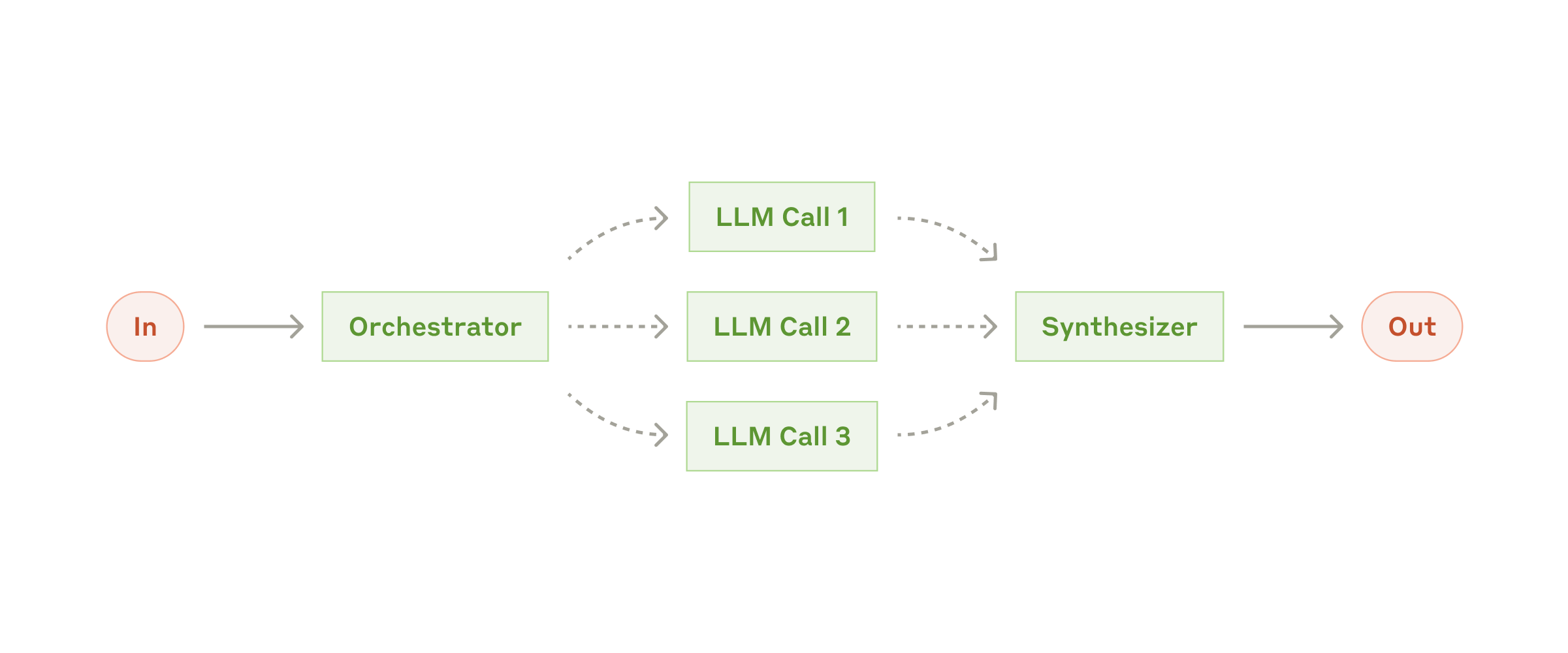
Orchestrator–workers: a lead agent delegates dynamic sub-tasks, then merges the output.
Source: Anthropic ↗Pattern framing adapted from Anthropic's "Building effective agents". In a hierarchical
squad the manager_agent is that orchestrator; in a sequential squad you draw the
delegation graph yourself with depends_on. Either way the shared state is the
blackboard.
Configuration
A squad is created with POST /squads (body wrapped in data, like all Strapi resources).
These are the fields that shape execution:
| Field | Type | Notes |
|---|---|---|
name | string · required | Human-readable name. |
slug | string | Auto-generated, unique; used nowhere in kickoff (kick off by numeric id). |
description | text | Optional. |
process | sequential | hierarchical | Execution strategy. Default sequential. |
manager_agent | relation → agent | Required for hierarchical; ignored for sequential. |
agents | JSON array | Squad members — { "agent_slug", "role" } per entry. |
tasks | JSON array | The task pipeline (see below). |
max_total_iterations | integer | Global budget across all tasks. Default 30. |
active | boolean | Default true. Inactive squads can't be kicked off. |
The tasks pipeline
Each task is one JSON object. The platform validates the pipeline — duplicate IDs, dependencies on unknown tasks, circular dependencies, and assignments to non-member agents are rejected before a run.
| Field | Required | Meaning |
|---|---|---|
id | yes | Unique task ID, e.g. "research". |
description | yes | What the assigned agent should accomplish. Supports {{context}}. |
agent_slug | yes | Which squad member runs this task. Must be in agents[]. |
depends_on | no | Array of upstream task IDs. Omit (or []) for a root task. |
output_key | no | Blackboard key the result is written under. Defaults to the task id. |
expected_output | no | Guidance appended to the agent's goal to shape the answer. |
A task's per-agent iteration cap is the smaller of the agent's own max_iterations and the
squad's remaining max_total_iterations budget — so a long pipeline can exhaust the budget
and later tasks are skipped (see Build a squad → Troubleshooting).
The blackboard
The blackboard is shared state. Each task writes its result to a named output_key;
downstream tasks read only from the keys their depends_on produced (unrelated parallel
branches stay isolated). Root tasks receive the raw user inputs. Agents build on each other's
work without talking directly.
The kickoff inputs are seeded onto the blackboard first under their own keys (task ID
_input, agent _system), so a root task whose description references {{context}} resolves
against the user's query.
Audit trail
Every write is appended to an audit trail — one entry per write, in order:
"audit_trail": [
  { "task_id": "_input",  "agent_slug": "_system",    "key": "topic",    "timestamp": 1710859200.12 },
  { "task_id": "research", "agent_slug": "researcher", "key": "research", "timestamp": 1710859231.74 },
  { "task_id": "write",    "agent_slug": "writer",     "key": "draft",    "timestamp": 1710859258.30 },
  { "task_id": "edit",     "agent_slug": "editor",     "key": "final",    "timestamp": 1710859275.91 }
]
The matching blackboard snapshot is the final value of every key:
"blackboard": {
  "topic": "AI in healthcare",
  "research": "Key findings: …",
  "draft": "A first-draft report …",
  "final": "A polished report …"
}
timestamp is epoch seconds. Together these give full traceability of who produced what,
under which key, and when.
Sequential vs hierarchical
| Sequential | Hierarchical | |
|---|---|---|
| Order | Fixed — tasks topologically sorted by depends_on | Decided at runtime by a manager agent |
| Who drives | The platform, task by task | The manager_agent via a delegate tool |
| Needs | tasks[] with dependencies | manager_agent + agents[] (tasks are hints) |
final_output | Concatenation of each task's answer | The manager's synthesized answer |
| Best for | Predictable pipelines: research → write → review | Dynamic work where order can't be fixed up front |
Pick sequential when you can draw the dependency graph yourself — it's deterministic, cheaper, and each step is independently auditable. Pick hierarchical when the work is exploratory and the right order depends on intermediate findings.
How each executes
- Sequential — tasks are topologically sorted, then run one at a time. Each task gets the
blackboard summary of its
depends_onkeys, runs its agent, and writes the answer to itsoutput_key.final_outputconcatenates the per-task answers. - Hierarchical — the
manager_agentis given the member list and the task descriptions, plus adelegatetool. It callsdelegate(agent_slug, …)to dispatch work in whatever order it reasons is best, then synthesizes the results.task_resultsreports a singlemanagerentry.
Both strategies share the same max_total_iterations budget (default 30) — a guardrail
against runaway delegation or a stuck pipeline.
Reference
Full schema and endpoints: Squad API. Member agents: Agents. To build one hands-on, see Build a squad.